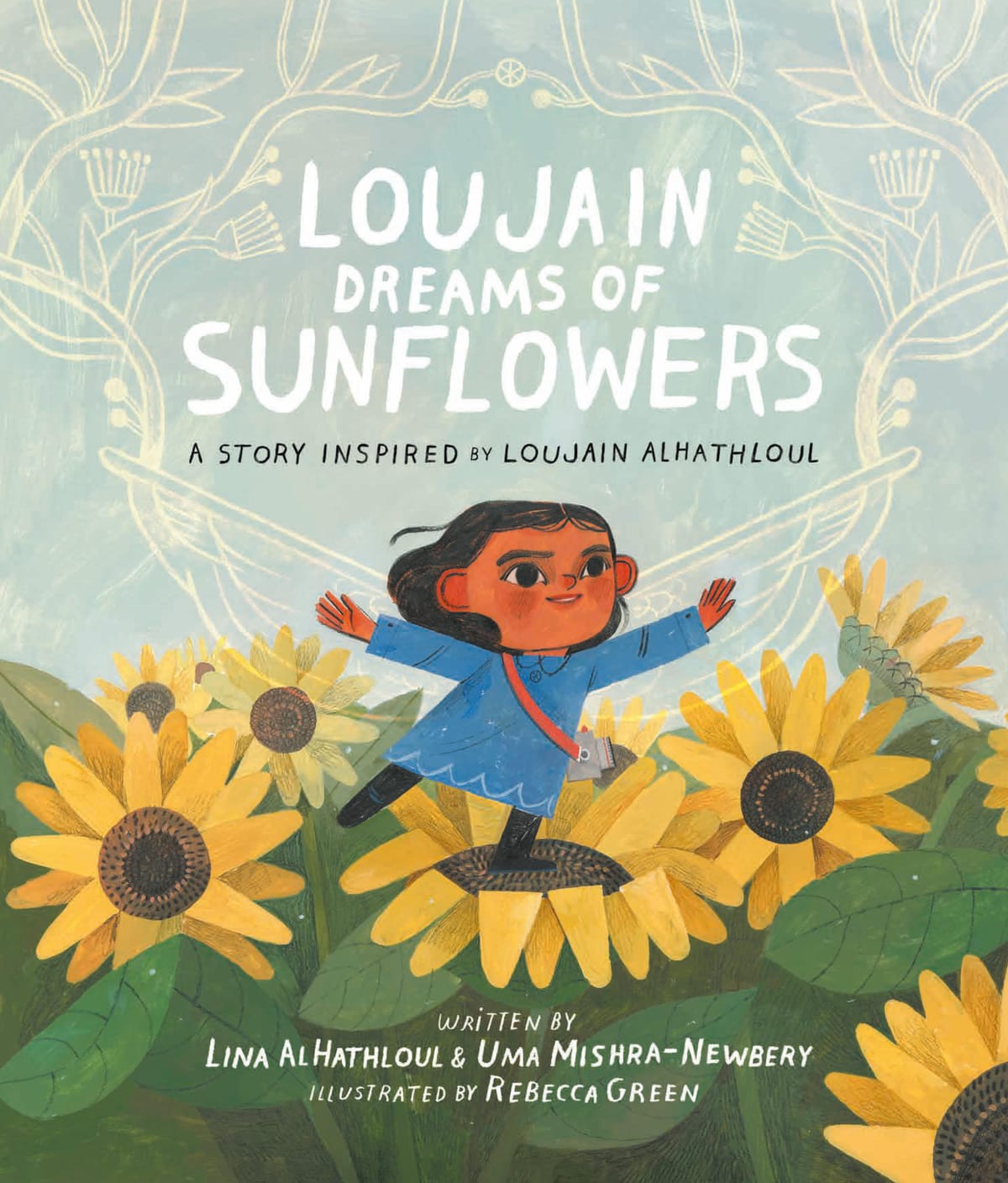
Three Years of Loujain Dreams of Sunflowers

I meant to write this on Human Rights Defenders Day (9 December), but I am just coming out of a week-long fever and catching up with life. And still, I think it makes sense that I am writing this now, a few days later, because so much of the work of human rights defenders happens off calendar, off hours, and in between the cracks of so much: life, school, family, heartbreak, health scares, and more.
This year marks over three years since Loujain Dreams of Sunflowers was published. In the past three years, the book has travelled farther than either Lina or I could ever have imagined, across languages (now translated into French, German, English, Korean, and Persian), classrooms, advocacy spaces, and into conversations we did not predict we would be invited into. And still, this story and book remain what they were inspired by: a story about a young girl dreaming of freedom and dignity - the story of Loujain AlHathloul.
When we wrote Loujain Dreams of Sunflowers, Loujain herself was in prison, and Lina could neither speak to her sister nor contact her. We could not ask Loujain about her favorite flower or whether she liked the story; we only knew that we had to tell her story outside the traditional advocacy spaces where the fight for her freedom was taking place. We wanted to write a story that could be read by children and by the adults around them who are still learning how to speak about repression, courage, and hope without flattening the stark realities human rights defenders like Loujain face.
Over the past three years, I have watched our small but mighty book become part of broader feminist and human rights conversations in ways that feel deeply humbling to witness. Most recently, I was grateful to join a panel with PeaceWomen reflecting on feminist advocacy, narrative, and the role of storytelling in sustaining long-term movements for justice.
"...advocacy doesn't only live in policy briefs; it lives in culture and imagination. She (Uma) and Loujain’s sister co-wrote a children’s book, Loujain Dreams of Sunflowers, to humanise the women’s rights struggle in Saudi Arabia and reach audiences outside policy circles." -PeaceWomen, Feminist networks: advocacy built for endurance.
What has stayed with me from that conversation is a shared understanding that advocacy is never just about policy change; it is also about imagination, about who gets to be seen as a defender, a dreamer, and about how we tell stories that do not reduce people to their persecution, but honor their full humanity.
Children's literature is often dismissed as trivial (especially in the age of children's picture books written by celebrities whose massive PR budgets and machines overwhelm the small PR budgets of indie writers - but that is a story for another day), and yet it is my favorite form of literature to write. I have come to understand children's literature as one of the most durable forms of advocacy. Stories shape how children understand the world and how adults learn to speak honestly without spectacle or performance. Loujain Dreams of Sunflowers continues to remind me that human rights work is not only reactive, but it can, and must be, generative.
I am especially grateful this year that this book is being held by others in such wonderful ways. Loujain Dreams of Sunflowers is currently part of two open literary competitions in France (thank you to our French publisher Les 400 Coups, for championing our book):
- The Prix UNICEF de Littérature Jeunesse, which centres stories that speak to children about rights, dignity, and global solidarity.
- The Prix des Incorruptibles, one of France’s largest children’s literature prizes, where young readers themselves are central to the selection process.
In a world where there is so much noise, there is something profoundly moving about knowing that children are encountering this story, not as a lesson, but as an invitation to think, to ask, to feel.
For me, this feels especially resonant this week of Human Rights Defenders Day. Defenders are not only those standing at podiums or in courtrooms. They are also writers, teachers, caregivers, artists, and children who learn early that justice is something you can imagine and grow towards.
Three years on, I see Loujain Dreams of Sunflowers not as a finished thing, but as part of a longer arc. One book in a much larger tapestry of feminist advocacy, movement-building, and care.
And perhaps that is the work:
to keep telling stories that hold complexity without despair,
to keep making space for dignity,
to trust that even small seeds, planted intentionally, continue to grow.
With care,
Uma
PS: Stay tuned for updates on my next children's picture book, Breathe the Rhythm of Your Heart, coming in 2027!
Here are a few ways to stay connected with Loujain Dreams of Sunflowers:
- Explore the free teaching guide for Loujain Dreams of Sunflowers—adaptable for classrooms, homes, and community spaces anywhere, with beautiful activities and coloring pages for young readers:
https://astrapublishinghouse.com/resources/teachers-guide-for-loujain-dreams-of-sunflowers - If you are in France, follow the book’s journey through the Prix UNICEF de Littérature Jeunesse and Prix des Incorruptibles, where children and educators are actively shaping the prize selection!
- As a former teacher, I love sharing classroom space with students and would love to share the story of this book and the publishing process with your students/communities. Feel free to connect with me (scroll down) on my website: https://www.umamishranewbery.com/books
P.S.
It is not lost on me that, across global development and social justice spaces, there is a growing and much-needed attention to narrative change, to whose stories shape our collective imagination, and how power moves through language, images, and memory. I see this shift happening more openly now, and I am grateful for it.
And still, a gap remains.
Too often, children’s literature is dismissed as peripheral or “soft,” even as we speak about the urgency of narrative power. Stories for children are treated as adjacent to the work, rather than central to it, as though imagination, dignity, and the seeds of justice are meant to be introduced later, after the “real” work is done.
But if narrative change is about expanding what is possible, then children’s stories are not trivial; they are foundational. They are where many of us first learn who belongs, who is brave, who is worthy of care, and whose freedom matters. If these stories do not reach our movement spaces, if they are not taken seriously as part of our shared strategy, then we risk reproducing the very fractures we say we are trying to heal.
This is something I am still sitting with, and something I want to return to more fully: how children’s storytelling fits into long-term movement strategy, and what it might mean to take these narratives seriously as part of the work of justice itself.
More on this soon. :)