Belonging as Sacred Struggle
What does it mean to belong? Even pigeons show us: gathering around their fallen kin in an act of return. As bell hooks wrote, “Only through discussion and disagreement could we begin to find a realistic standpoint.” Belonging is forged in struggle, refusal, and love.


This piece explores the connections between pigeons, ancestors, political prisoners, and conflict as a means of belonging. It is long, and it is tender. Thank you for sitting with it. And still, life holds so many textures at once. As I finish this today, the sun is out, and my daughter and I are both wearing my father’s sweaters from the 90s, sitting in the light with glasses of freshly squeezed pomegranate juice from the market. There is grief, and there is struggle—and there is also this: sweaters a size too big but well-lived in and connected to ancestry, tart juice, and the heat of the sun on our faces.
There was a pigeon that had been run over on the street the other day.
As I left the apartment to pick up my daughter from school, I saw it. It had already been flattened, and I breathed in hard as I passed. There was little left to move to the roadside. When I walked back with my daughter, there were other pigeons flocking around their flattened kin.
It was only hours later that I realised what the other pigeons were doing. They were visiting the body—the flattened shell of their kin.
Pigeons are deeply social beings. They have been bred to be around humans (which we have forgotten), which is why they are always near us, why we so often label them a nuisance. But where else would they go, when we have shaped their belonging to be here, among us?
These pigeons, one by one, visited the body. They hopped close, paused, picked up a little bit, and then moved away. And I stood watching, realising this too was an act of belonging for them. A deep act of return.
We hear, especially in the social justice space:
We belong to each other.
We belong to each other.
We belong to each other.
But what does that mean?
How do we practice it in the human world, when in the animal world, the state of belonging exists in perpetuity. We belong to each other, and so we belong to the earth—the soil that decomposes our bodies, the bacteria, the birds, the beetles, the insects that receive nourishment from death. Nature shows us: even in death, we belong to each other.
And yet we question.
We question our belonging.
We question our validity, our right to exist, our right to take up space.
We are told—sometimes quietly, sometimes violently—that we do not belong here. Not at school, not on our land, not at work, not in our families, not in our bodies.
And so we begin to question if the very cells that make us up—these thousands of particles and molecules, no different than the water molecules/steam rising from a cup of tea—are valid.
Because we question our belonging, we question the validity of our voice.
We question if we have something to say.
We question if our idea is valid, if the way we organize is valid, if the relationship we are in is valid, if the course of study we choose is valid.
I recently reread Feminism Is for Everybody by our ancestor, bell hooks. She is an author I return to again and again, pulling her words down from my shelf whenever my spirit needs a reminder.
One theme that I was reminded of again was the need for space—for practice, for struggle with ideas, for disagreement, for conflict. hooks wrote about the power of Consciousness Raising groups in the early feminist movement: they gave people room to wrestle with the indoctrination of patriarchy and its symptoms. But she also noted how those same groups eventually became spaces where women simply unleashed rage, without moving toward transformation.
This tension feels alive in movement spaces today. We want to organize against racism, patriarchy, and intersecting oppressions, and we do hold some space for people to share their experiences. But we often do not know how to hold, in an embodied way, the space where disagreement shows up—especially when it challenges our personal views.
hooks reminds us: “Only through discussion and disagreement could we begin to find a realistic standpoint.”
When those spaces are not created, movements fracture. We have seen it before. We are seeing it again. And yet, history also reminds us that movements are not meant to be perfect—they are meant to be practiced. Struggled with. Lived into.
In my own life, I have struggled to call myself a feminist because of the higher value placed on theorising around feminism (feminist leadership, feminist organising, feminist care, feminist movement building, etc). And still, I cannot write off the whole of the feminist movement. Because history shows us: if we are going to reach our shared goals, we need to practice—again and again—with each other.
This week, as I held these thoughts, I also learned of the passing of ancestor Assata Shakur—on the birthday of ancestor bell hooks. Two women who, in such different ways, carved pathways of resistance and insistence. Their legacies remind us that belonging is not static or simple—it is forged in struggle, in refusal, in love.
I want to share this beautiful reflection by Shapel Monique LaBorde: She Lived, and Yes, She Loved Us: A Fugitive Benediction Between bell and Assata. It is utterly beautiful and should be read.
Together, bell and Assata remind us that love and struggle are not opposites but braided together—that belonging is as much about rage and refusal as it is about tenderness and care.
And so I return to this truth: we have been taught by whiteness, by white supremacy culture, by white body supremacy, to avoid conflict. To “keep the peace.” To smooth over differences with ourselves, our families, our movements.
But conflict is generative.
It is meant to create friction, to generate tension and fracture, to invite entanglement and untangling. It is meant to bring forth heat—because without the heat, there is no transmutation.
Even the core idea of belonging requires this. If we avoid conflict entirely—if we refuse to go into the depths, to do the undercurrent work of facing what we have hidden away—we miss so much. We forego the deepening of our power and rootedness with each other.
As I speak this, crows are flying overhead. I am waiting for my daughter to finish an activity. I sometimes write this way, voice journaling aloud, then transcribing and completing.
And as I reflect, I want to say this:
Here too is a place where you can struggle.
Here, conflict is not avoided.
Here, conflict is a sacred part of belonging.
The chain of belonging, nourishment, and return holds both the breaking and the weaving back together. Sometimes we must do a postmortem—to hold, examine, and understand—before we can move toward repair.
Here, all of it is held.
This past week, Alaa Abd El-Fattah was freed after ten years in prison. His mother, Laila, has been on a hunger strike for more than 300 days, fighting for her son’s freedom. In a video, Alaa embraces his mother. She says, “I wish other families could experience this too.”
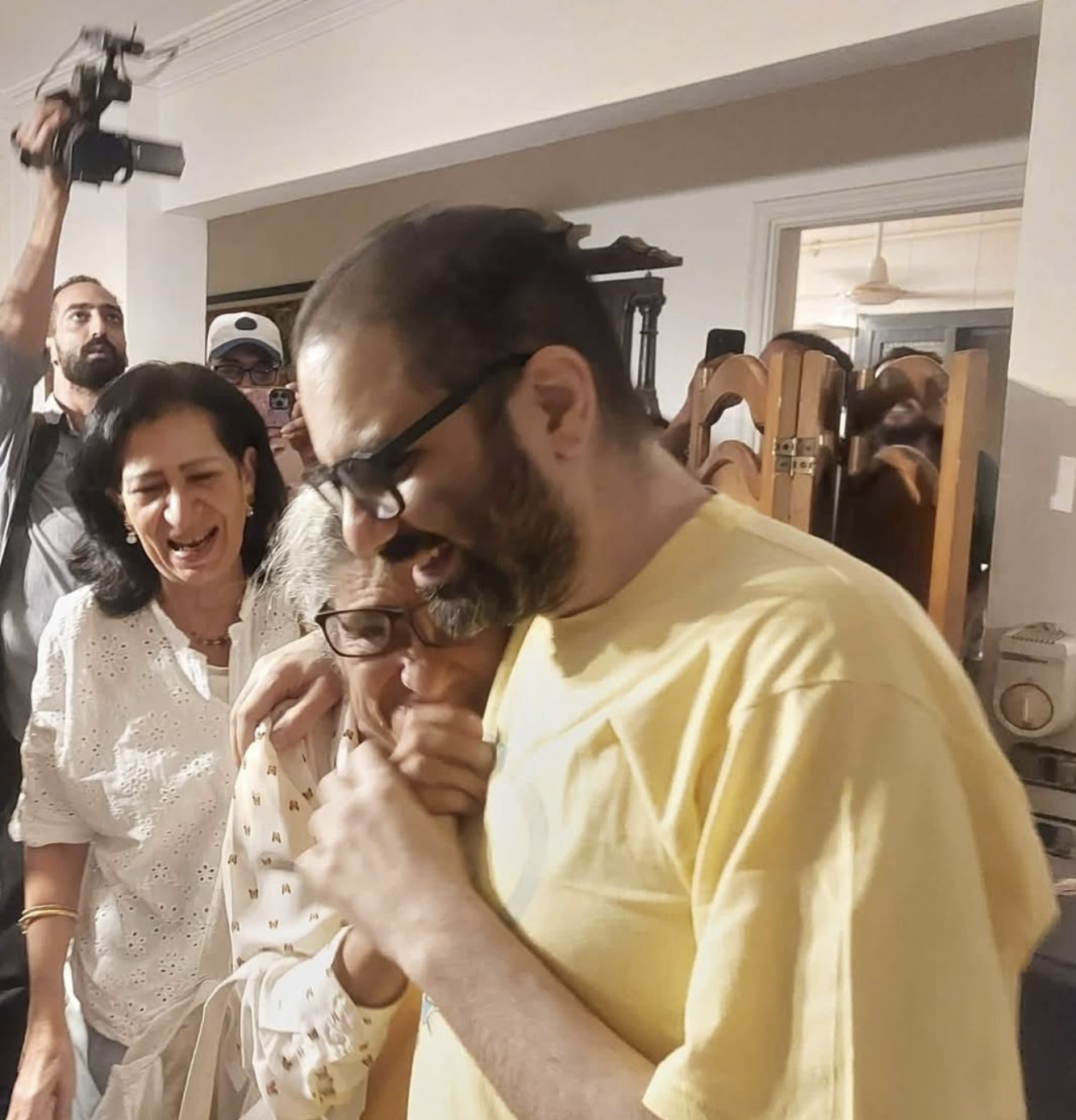
Is that not the essence of belonging?
How beautiful, how large-hearted, how deeply interconnected, that a mother who has endured so much violence, who has struggled and suffered for years, would in that moment speak not only for herself but for other families.
This is what it takes to belong to each other: sacred struggle, deep struggle.
It is messy. It must be, sometimes. But it can also be loving, intentional, and necessary.
I send you all love in these moments of struggle ahead. And I know we will prevail, as we continue to journey toward our belonging—together.
With deep love,
Uma